September


IS SEPTEMBER A GOOD TIME TO VISIT VIETNAM?
Yes in the north, and this is the month the northern half of Vietnam begins its best season.
September is also when the harvest arrives in the terraced valleys, when the central coast closes for the year, and when a narrow value window opens before autumn demand builds. It is a month of transitions rather than settled conditions.
This page sets out where September works, what it uniquely offers, and the one region to leave out entirely.
THE SHORT ANSWER
Go north, and go in the second half of the month if you can.
The northern half of the country clears and cools through September, opening the strongest luxury travel season in the year. The terraced valleys begin their harvest. The south-central coast remains dry.
The central coast closes. From September the region enters the wettest part of its year with genuine typhoon risk, and it stays that way until February.
Early September is also the last of the luxury travel value window that began in late August, before international demand arrives.
THE HARVEST BEGINS
The single strongest reason to visit Vietnam in late September and the thing most photographers come for.
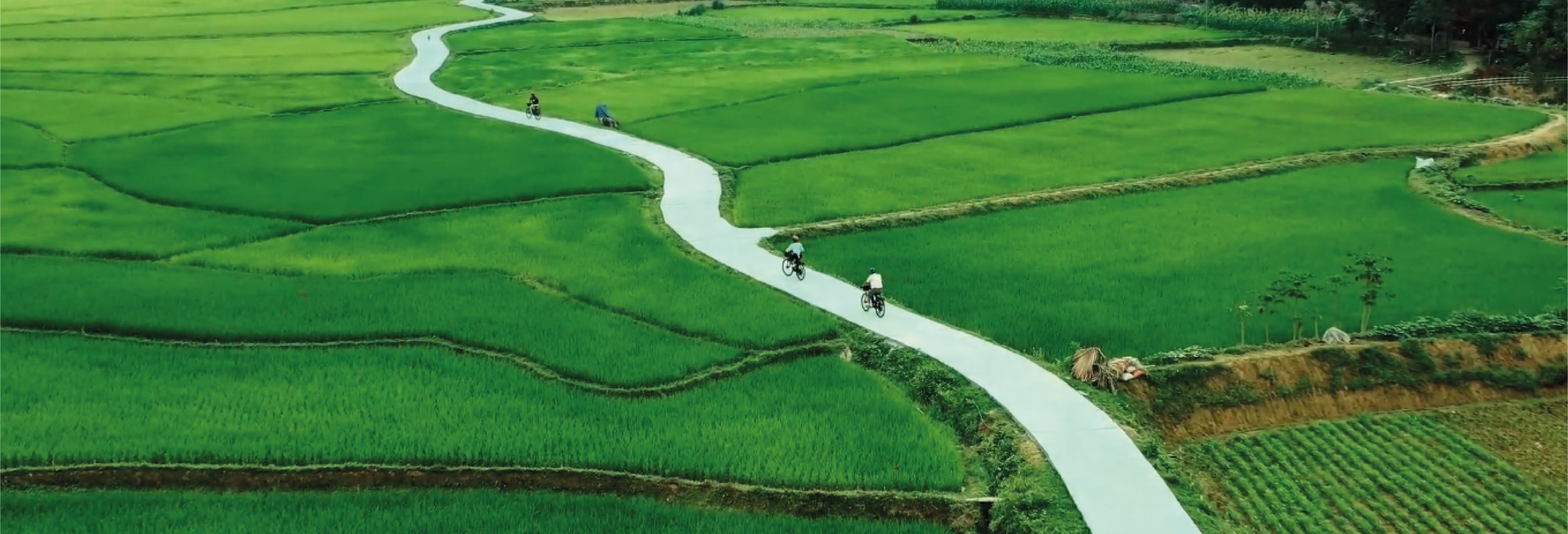
The terraced valleys in the northern mountains ripen through the second half of the month, and the hillsides turn gold in sequence rather than all at once. Cutting begins in the earliest valleys while others are still green.
It is the most photographed landscape in Vietnam, it deserves the reputation, and it is the strongest exclusive Vietnam travel subject of the autumn. Whole mountainsides of stepped gold, worked by hand, with the cutting and threshing visible in the fields.
The timing moves by up to a fortnight from year to year and cannot be looked up. Somebody has to go and look at the fields, which is exactly what a Vietnam Travel Luxury DMC exists to do, and any luxury travel agency quoting a fixed week is guessing.
Late September into the first half of October is the reliable window. Anybody arriving in early September will find green valleys and a lovely landscape that is not the one in the photographs.
THE NORTH OPENS
The transformation through September is considerable and it is the reason to come.
The rains ease, the humidity drops, and the air clears. By the end of the month the capital is comfortable rather than oppressive, and the light improves markedly.
The limestone bays settle, with visibility improving and seas calming. Typhoon risk persists through the month and diminishes towards the end, so a bay charter still needs a contingency rather than an assumption.
The inland karst is green, with the second rice crop ripening towards late September, which produces a golden landscape ninety minutes from the capital and requires no trekking at all.
For any luxury travel itinerary weighted north, September begins a run of excellent months continuing into December.
THE CENTRAL COAST CLOSES
This needs stating plainly because it is the most consequential thing on the page.
The central coast wet season begins in September and runs through December, with October and November heaviest. Rain becomes persistent, the sea turns rough, and the heritage town floods most years.
Typhoon risk is genuine from now on. Storms make landfall on this coast, and when they do, flights are cancelled and roads close.
We do not include the central coast in September luxury vacation packages. Where a client asks, we explain why and reshape the luxury travel itinerary rather than take the booking. February is when the region reopens properly.
That single exclusion reshapes most September itineraries, and it is the change clients most often resist and most often endorse afterwards.
THE VALUE WINDOW
The first two weeks of September are worth knowing about.
Vietnamese schools have returned, so domestic beach and highland demand has gone. International autumn demand does not begin until the last week of the month. Northern weather is improving while rates have not yet risen.
The result is a genuine gap: improving conditions at low-season pricing, with guides, drivers and the better properties all available.
The catch is the harvest, which has not yet arrived. So early September buys value and late September buys the landscape, and a client cannot have both.
Which matters more is the first question we ask about any September luxury travel plan, and the answer determines everything else.
THE MID-AUTUMN FESTIVAL
Usually falling in September, on the fifteenth day of the eighth lunar month, this is among the more charming occasions in the Vietnamese year.
Lanterns appear in the streets, mooncakes are everywhere, and children carry lit lanterns in processions. The heritage town on the central coast observes it beautifully, though the region is wet by then.
In the capital the old quarter fills with lantern sellers and the atmosphere is genuinely festive. It works particularly well in a luxury family vacation, since it is the one Vietnamese festival built around children.
The date moves with the lunar calendar and needs checking annually rather than assuming.
THE SOUTH
Still in the wet season, with the pattern that makes it manageable.
Mornings are usually bright. Rain arrives heavily in the afternoon, lasts an hour or two, and clears. Evenings are frequently fine.
The delta reaches its flood peak through September and October, a genuinely different landscape from the dry season and an unusual private Vietnam experience. Channels become open water, the flooded forest is navigable by sampan, and the fishing changes entirely. It is more dramatic than the dry delta and considerably less visited.
Luxury travel rates in the southern city remain low, which makes a short city and delta leg good value alongside a northern itinerary.
THE ISLANDS
The southern island is wet through September, with rain heavy and boat trips unreliable. It is quiet and cheap and not the reason to come.
The remote southern archipelago is in the last of its calm window, with the reef still workable and turtle nesting finishing, which makes it the final luxury adventure travel opportunity of the year there. By October the northeast monsoon closes it.
The central coast islands close with the mainland.
The bay islands in the north improve through the month as the storms recede.
THE MOUNTAIN ROADS
The landslide season eases through September, and it does not end at the start of the month.
Early September still carries genuine risk on the higher passes, and roads can close with little warning. By the second half conditions are considerably more reliable.
For a harvest itinerary this matters, because the harvest and the improving roads arrive at roughly the same time. That is convenient rather than coincidental, and it is why late September is the answer for the mountains rather than early.
We still build contingency into mountain legs this month, and we do not schedule one immediately before an international departure.
IS IT GOOD VALUE?
Two halves moving in opposite directions.
The first fortnight is genuinely good value for luxury travel, with low-season pricing and improving weather.
The second half sees rates rise as autumn demand arrives, and the mountain lodges during the harvest weeks are the tightest inventory of the year.
So September contains both the last cheap window and the start of the expensive luxury travel season, which is unusual and worth planning around deliberately.
WHAT SEPTEMBER UNIQUELY OFFERS?
The harvest in the terraced valleys, which belongs to late September and October alone.
The second karst rice crop turned gold near the capital.
The delta at its flood peak, which is a different place from the dry-season delta.
The mid-autumn festival, the one Vietnamese occasion built around children.
The last of the turtle nesting and the reef on the remote islands.
WHAT SEPTEMBER DOES NOT OFFER?
A workable central coast, at all.
The flooded terraces, which are May and June.
The buckwheat on the far northern plateau, which is October and November.
Reliable bay conditions in the first half of the month.
A beach week anywhere except the south-central coast.
WHERE TO SEE THE HARVEST?
Three valleys carry most harvest luxury travel itineraries, and they suit different clients.
The famous northern mountain valley is the most accessible and the most photographed. Good properties, a proper town, and terraces visible from the road. It is also the busiest, and the town itself has grown faster than its infrastructure while the valley below has held up considerably better. Most luxury vacation packages use it and stay in the valley rather than the town.
The valley two hours further on is quieter, with fewer properties and more walking. For anybody wanting the landscape without the crowds it is the better answer, and a genuine private Vietnam experience.
The far northern plateau along the Chinese border is a different proposition again: limestone towers, a gorge road cut into a cliff, and terraces on a smaller scale. Border permits are required for foreign visitors and we arrange them in advance. Accommodation is characterful rather than luxurious, which clients should know before booking.
Our recommendation for a first harvest trip is the main valley with a property facing the terraces, and for a returning client the quieter valley. Either makes a strong bespoke Vietnam journey and neither works without the timing being right.
WHAT THE WEATHER ACTUALLY FEELS LIKE?
Numbers understate September, so it is worth describing.
In the capital the first fortnight is humid with afternoon rain and the second is genuinely pleasant, warm and clearing, which is when luxury travel here becomes comfortable again.
On the northern water it improves steadily. Early September can be grey and unsettled; late September is calm with good visibility and warm swimming.
In the mountains it is mild and green early, then clear and cool as the harvest arrives, with cold nights at altitude by month end.
On the central coast it is wet, grey and rough, which is why it is excluded.
In the south it is hot with the daily downpour, and the delta is at its flood peak.
THE FOOD IN SEPTEMBER
A strong month, and the harvest brings something genuinely seasonal.
New rice appears in the northern valleys as the crop is cut, and it is a different ingredient from stored rice. Sticky rice pounded fresh, green rice flakes made from young grain, and the dishes built around them exist for a few weeks only. It is among the more distinctive things available in any luxury travel itinerary here.
The mid-autumn festival brings mooncakes in every conceivable variety, from the traditional lotus and salted egg to modern versions, and the good bakeries in both cities are worth visiting.
The flooded delta changes the fishing entirely, and the freshwater catch of the flood months is a different menu from the dry season.
Seafood on the south-central coast remains excellent while the seas stay calm there.
For a food-led high end Vietnam vacation, late September is stronger than the celebrated spring months.
WHAT IS UNAFFECTED BY SEASON?
Worth restating, since the central coast exclusion can make September look constrained.
The cities are entirely season-independent, and the northern capital improves through the month. Food, museums, architecture, markets, craft villages, tailoring and galleries are unaffected by weather.
Conservation programmes run year-round. The primate rescue centre, the coastal douc langurs and the wetland reserve are all available, and the wetland is at its most striking during the flood.
Cultural access is unaffected and largely indoors. A household kitchen, a lacquer studio, an indigo dye vat, a court music ensemble and a calligrapher are the same in any weather, and each makes a genuine exclusive travel experience.
A structured luxury wellness retreat is close to weather-proof, and the highland properties are cool and green.
For a client whose interests are cultural or culinary rather than scenic, September in the north is a straightforwardly good month, and the first fortnight is the cheapest good month in the second half of the year.
SEPTEMBER OR OCTOBER
Worth comparing, since both sit inside the harvest window and clients frequently choose between them.
October is the better month overall. The north is drier and clearer, typhoon risk has receded, bay visibility is at its annual best, and the buckwheat appears on the far northern plateau.
September's advantages are narrower: the first fortnight is materially cheaper, the earliest valleys are cutting while October's are still standing, and the delta flood is at its peak.
Where a client can choose freely, October is the answer for the north and the honest recommendation even though September rates are lower.
Where dates are fixed in September, the second half is the part to use, and the trip remains excellent.
WHAT TO PACK?
Lightweight clothing with genuine waterproofs, which will be used.
Layers for the northern mountains, which cool noticeably at altitude by late month.
Footwear with grip for the terraces, where paths turn to slick clay within minutes of rain.
Insect repellent, which matters more in the wet months.
THE ITINERARIES THAT WORK
The northern harvest route in late September: the capital, a bay charter with contingency, the inland karst as the second crop turns, then four or five nights in the terraced valleys. This is the strongest September luxury travel itinerary and the reason to choose the month.
The north and the flooded delta, pairing the capital and the bays with a southern leg while the water is high.
The south-central coast has a beach base, since it stays dry while the central coast closes and holds several of the best luxury resorts in the country.
An early-September value route through the cities and the karst, before rates rise and while the weather is improving.
WHAT WE WOULD NOT BUILD?
Anything on the central coast.
A harvest itinerary in the first half of the month.
A bay charter without a genuine alternative held in reserve.
A diving trip to the remote southern archipelago in the final week, as the monsoon arrives.
LEAD TIMES
Five to six months for the mountain lodges during the harvest weeks, which are the scarcest inventory in the Vietnamese calendar.
Four months for the bays and the northern properties in the second half of the month.
Six to eight weeks is frequently workable in the first fortnight, which is part of its appeal.
Longer for the cave allocation and the twelve-guest carriage, which are constrained year-round.
SEPTEMBER BY TRAVELLER TYPE
The month suits some groups considerably better than others.
Photographers should come in the second half, and September is among the two strongest luxury travel months in the year for the northern landscape.
Couples do well in the north from mid-month, and the harvest valleys are among the more memorable luxury honeymoon destinations settings in Asia for anybody who prefers landscape to beach.
Families are constrained by term dates, and September rarely works for them. Where it does, the karst and the capital are better than the mountains.
Groups do well in the north late in the month, though the mountain lodges are small and a party of eight needs early commitment.
Older luxury travel clients should take the karst rather than the mountains, since walking in the terraced valleys is genuinely demanding on wet clay.
Solo travellers do particularly well in the mountains, where the walking is the point and a specialist guide costs very little.
HOW LONG THE HARVEST WINDOW ACTUALLY LASTS?
Worth being precise, because clients plan around vague advice.
Each individual valley holds its gold for roughly ten days to a fortnight between full ripeness and cutting. Across the northern mountains as a whole the sequence runs perhaps five weeks, from the earliest valleys in mid-September to the latest in mid-October.
That means the country has a harvest for over a month while any single place has one for a fortnight. Which is why the choice of valley matters as much as the choice of week, and why we sometimes move a client's mountain leg between valleys rather than moving their dates.
It also means a fixed set of dates can almost always catch the harvest somewhere, provided the itinerary is built after the fields are checked rather than before.
That is the single most useful thing we do in September, and it is not something an overseas luxury travel agency can replicate from a desk.
HOW WE BUILD IT?
We are a Vietnam Travel Luxury DMC operating here rather than brokering from abroad, and in September the value is almost entirely in timing the harvest.
The gold arrives on its own schedule and moves by a fortnight. We check the valleys before confirming rather than quoting an average, and where a client's dates fall early we say honestly that the terraces will be green.
A local operation also knows which mountain properties face the terraces rather than the road, carries the storm contingency for the bays, and declines the central coast rather than selling a wet fortnight.
For anybody weighing a high end Vietnam vacation in September, the month is excellent in the north, closed in the middle, and workable in the south, and the harvest is worth planning the whole trip around.
ENQUIRIES
We plan for travellers from the USA, Canada, the UK and Europe, the Middle East and Singapore, and September marks the start of our strongest season for northern itineraries.
Tell us your dates and whether the harvest matters, because that single answer determines whether we aim at the first fortnight for value or the last for the landscape. Tell us if the central coast was in your plan, so we can explain why it should not be. We quote against your actual dates rather than publishing figures, since rates climb sharply through the month. Good luxury travel in September means going north and getting the timing right by a fortnight.
Vietnam Luxury Travel DMC for HNWI, Vietnam Luxury Travel DMC for UHNWI, Vietnam Luxury DMC for HNWI, Vietnam Luxury DMC for UHNWI, Luxury DMC for HNWI in SEA, Luxury DMC for HNWI in Southeast Asia, Luxury DMC for UHNWI in SEA, Luxury DMC for UHNWI in Southeast Asia, Luxury Travel DMC for HNWI in SEA, Luxury Travel DMC for HNWI in Southeast Asia, Luxury Travel DMC for UHNWI in SEA, Luxury Travel DMC for UHNWI in Southeast Asia
What you'll receive

Tailor-Made Journey Design
Every journey is individually crafted around your passions, pace and preferences, with seamless service, privileged access and thoughtful attention to every detail.
Learn more
20+ Years of Deep Local Expertise
Over two decades of destination expertise, trusted relationships and flawless execution ensure access, flexibility, privacy and confidence throughout every journey.

Responsible Luxury
Luxury travel should leave a positive legacy - supporting local communities, preserving cultural heritage and protecting the natural environment for generations to come.
See more
Concierge-Level Journey Management
Our services include VIP airport handling, helicopter, yacht, and jet ski logistics, private charters, agile itinerary management, exceptional customization for Kosher, Halal, Vegan, and Wellness dining requirements.
Experience Now